We all know how it feels. You make what you thought was an innocent remark and suddenly you’re in a heated argument over politics. Or maybe you’re on your way to lunch when you realize that you’ve double booked yourself for the following afternoon, and it isn’t obvious how you’re going to get out of either commitment without paying a heavy cost. Or maybe you’ve just discovered that the presentation you thought was tomorrow, the one you haven’t prepared for, is actually today. In five freaking minutes.
Sometimes it’s even more elusive than that. A baseless fear or some old hurt gets dredged up by forces that are totally unobservable, yet still you find yourself in the grips, hijacked by your amygdala, cortisol and adrenaline flooding your body. Your pupils dilate, your breath becomes shallow, and your jaw sets. And while that quivering solar plexus and those shaking limbs might be useful if you had to fight off a bear or climb a tree to escape one, most of the time, this is the last thing you need.
Not only are these physical sensations unpleasant, when our bodies’ flight-or-fight responses get activated in this way, we lose the ability to think clearly, make complex decisions, and access multiple perspectives, which can cause us to get stuck in a rigid, defensive mindset. Our memories also become corrupted, which not only leads to more confusion, it can, in a conflict, cause us to forget that we ever liked the other person, even if it’s someone we love, making it more likely that we will do and say things we later regret.
Most people reading this will probably know first hand how a well-structured yoga class can help you downregulate your nervous system and that a regular yoga practice can lower your baseline away from these aggravated states, making you less likely to get triggered in the first place, but it will still probably happen from time to time, and unfortunately, it’s not always possible to bust out triangle pose whenever you get into an argument or start perseverating over some past offense or upcoming obstacle.
That’s why I thought I’d share these three techniques to help you quickly and efficiently calm your nervous system whenever you feel anxious, stressed, angry, or wired and it’s getting in your way.
1. The Physiological Sigh
The Physiological Sigh is an awesome technique that you can do just about anywhere. The technique is super simple. Take a quick, deep inhalation through the nose, then immediately suck in just a little more breath like you’re topping off your tank. Next, exhale completely and slowly through the mouth. Repeat for 2-3 rounds.
Here’s what it looks like (turn your volume on):
Here’s how it works:
When we’re stressed or anxious, our breathing speeds up and becomes shallow, which perpetuates the cycle of excitation. The two quick inhalations help to reset the pattern of breath, while the slow exhalation removes excess carbon dioxide from the body.
2. Extending the exhalations
Once we’ve been triggered and stress hormones have been released into our bodies, it takes fifteen or twenty minutes for them to clear out, and that assumes we don’t get locked into stress-inducing bodily patterns or patterns of thought that continue to release more stress hormones.
Not only is it a good thing to bear in mind that it will take a little time for you (or someone else) to calm down, it’s also helpful to have a technique that can be used to support that calming period and prevent you from unintentionally intensifying an excited state. One simple method that does both is the practice of extending your exhalations, and like the physiological sigh, this can be done almost anywhere.
How to do it:
Bring your attention to the breath moving in and out through your nose and count the length of your inhalations. Next, extend the length of your exhalation by a count of two. As an example, if your inhalation lasts for a count of 5, stretch your exhalation to last for a count of 7. By extending the exhalations in this way, you’ll inhibit the production of additional stress hormones and create what is known in yoga as a langhana effect.
Langhana, in this context, means to reduce or diminish back to its cause. According to Yogapedia, “In yoga asana practice, langhana postures are those that are more relaxing, slowing the heart rate, breathing and metabolism, relaxing the nervous system, and calming the mind.”
Again, this will take several minutes, so stay with it, returning to the breath count again and again each time your mind wanders. Focusing your attention on the count is important because it will help to prevent obsessive thinking or stress-inducing ruminations.
Please note that the exhalation doesn’t have to be extended exactly by two additional counts. You might prefer a rhythm with a slightly longer extension of the exhalation. Just make sure you don’t stretch the exhalation so far that it creates a strain.
3. The 61-Point Relaxation Technique
This is a technique I first encountered in a wonderful book called The Tibetan Yogas of Dream and Sleep, by Tenzin Wangyal Rinpoche. In it, the author introduces the 61 points as a method to induce lucid dreaming, but it can also be used as a stand-alone technique to calm the mind or as an entry point into yoga nidra, a state of non-sleep deep rest.
How to do it:
The practice is accomplished lying down and can take anywhere from a minute or so to upwards of ten. I’ve created a follow-along video below that you can try for yourself.
I frequently use this practice when I’m having trouble settling down at night or if I wake up and can’t fall back to sleep. I will also use it during the day when I’m feeling too keyed up and have a few minutes to lie down on the floor, couch, bed, or wherever, really.
Once you get accustomed to the practice, you can work with it on your own without the recording. Here’s a chart to help you learn the points in their sequence. You can download a printable pdf here.
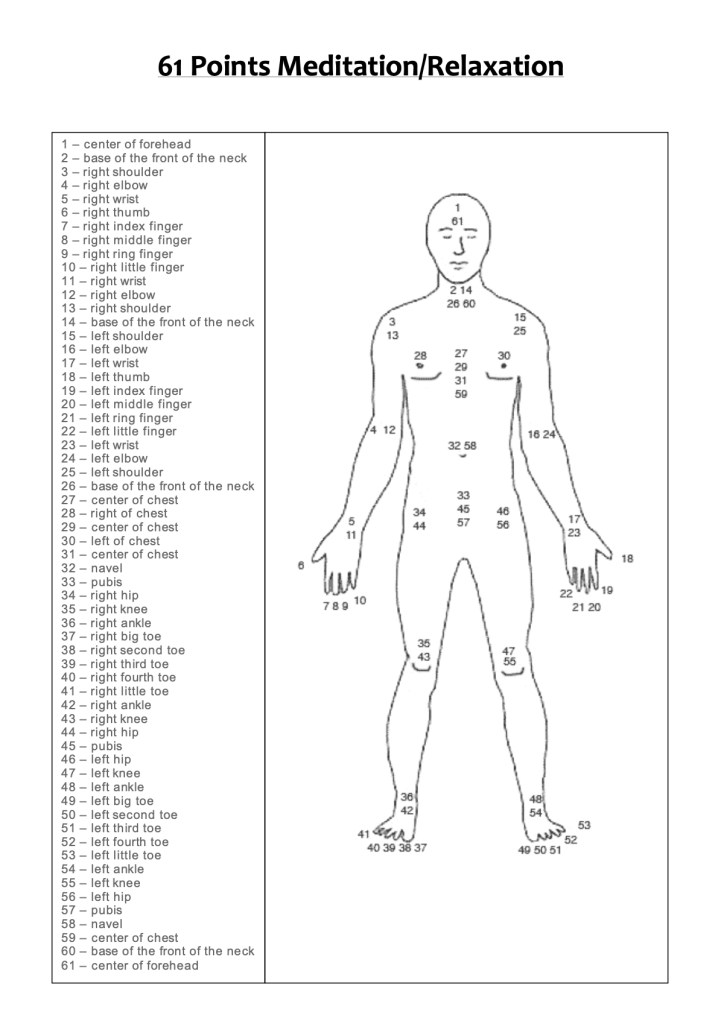
It should be said that none of these techniques are guaranteed or even likely to work in the face of extreme states of agitation, but they can become useful tools to help you manage various levels of undesirable arousal. I think it’s best to play around with them to see what works in different contexts and how they can be adapted to suit your needs.
That’s it! Let me know in the comments if you find any of these techniques useful or have any of your own to share.
If you’re looking for my current class schedule of in-person and virtual yoga classes or a link to some of my follow-along classes on YouTube, you can find both here, and if you’d like to get the blog by email to stay updated on future offerings, you can add your address below 👇 and click the button.

 suburbanyogadad.com