Have your attitudes about parenting changed during the pandemic? Mine have. I’ve been spending way more time with my kids. Way more unstructured time, and I’ve realized that a lot of the facets and aspects of parenting I’ve been avoiding–albeit mostly unconsciously–have been things I’m actually missing out on.
I share a lot of my energy with the kids. I always have, but until recently, it’s never really occurred to me to think of being a dad as a practice in the same way I think about my yoga asana practice or my meditation practice or my writing practice. My approach has been to just show up and do it in the way that seems best, not really seeking out advice or strategies to up my game.
But I’m starting to see things differently–starting to see the (now) obvious truth that my relationship with my kids is a major, if not primary, vehicle of my growth and transformation. My explicitly creative and spiritual practices have their part to play, too, of course, as do all the other experiences and endeavors that don’t fit into any of those cute, well-defined rubrics, but I already knew all that. 😁
One outcome of this shift in my thinking is that I’ve become more motivated to learn, and to that end, I’ve found a trio of pretty great books that have, in a short time, helped me noticeably improve my relationships with my children and create more harmonious home.
The Conscious Parent, by Shefali Tsabary.

The main thrust of this book is to help you develop a perspective from which you see you and your kid as two beings on a co-evolutionary journey with a responsibility to teach and learn from one another. It’s a premise I had no trouble accepting, even though in practice I’ve tended to parent as if I were sending edicts and wisdom down from the mountaintop. This book isn’t full of practical advice or strategies but rather uses anecdotes to explore the ways in which we can learn to identify our personal baggage as such and minimize the effect of unconscious habits and programming that interfere in our relationships with our kids.
2. How to Stop Losing Your Sh*t with Your Kids, by Carla Naumburg
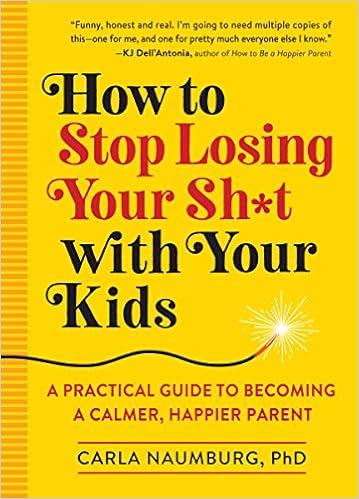
This book is full of practical advice and strategies based on the author’s experience, neurobiology, and developmental psychology to help learn to keep your cool. 😎 The tone is what you’d expect from the title and may not appeal to everyone, but I liked the conspiratorial, laid-back discourse and found it funny and candid without being glib.
A lot of the advice feels commonsensical (protect your sleep), but backed up with the science to explain why (if you’re sleep deprived, your prefrontal cortex goes offline and your limbic system takes over 🤓 ), I felt more motivated to put some of it into practice. Just learning a little bit about what happens to your neurons each time you lose your sh*t–not to mention what it does to your kid’s wiring–makes this worth the read. One invaluable thing I picked up from this book is learning how to recognize, in the moment, when I’m ramping up en route to a blow up. If you can see it’s happening, you can make a choice, and the author gives you lots of alternatives to help you avoid taking the nuclear option.
3. Raising Your Spirited Child, by Mary Sheedy Kurcinka.
My wife bought (and read) this book when we only had one child. I should have read it then.
Per the cover, the book is supposed to be for parents of kids who are more intense and/or sensitive than other kids, and while my kids each fit the description in their own ways, I should say I’m grateful not to have endured some of the more extreme and even bizarre stories shared by some of the parents in the author’s support group.😬
Having said that, even if you don’t think of your kid as being particularly “spirited,” this book has a lot of great information to help you relate to kids (all people, really) with different temperaments and emotional-processing styles. It can also help you help your kids learn to self regulate and is full of useful strategies to create a mutually supportive and nurturing family culture.
I’m probably going to listen to these books again and might share some of the more helpful info in future posts, but for now, here are some things you can do, according to Mary Sheedy Kurcinka, to turn your family into a “problem-solving family.”
- If you hit a roadblock, back off. Give everyone a chance to unlock.
- Seek understanding of why this issue is important to your child.
- Explain what is important to you.
- Solve the problem together. Invite your child to brainstorm potential solutions that work for both of you.
I hope you find some of these books useful. If you have any thoughts on them or other titles you think I might like, please share them in the comments. ✊ ❤️ 🙏 🕉 🤙
 suburbanyogadad.com